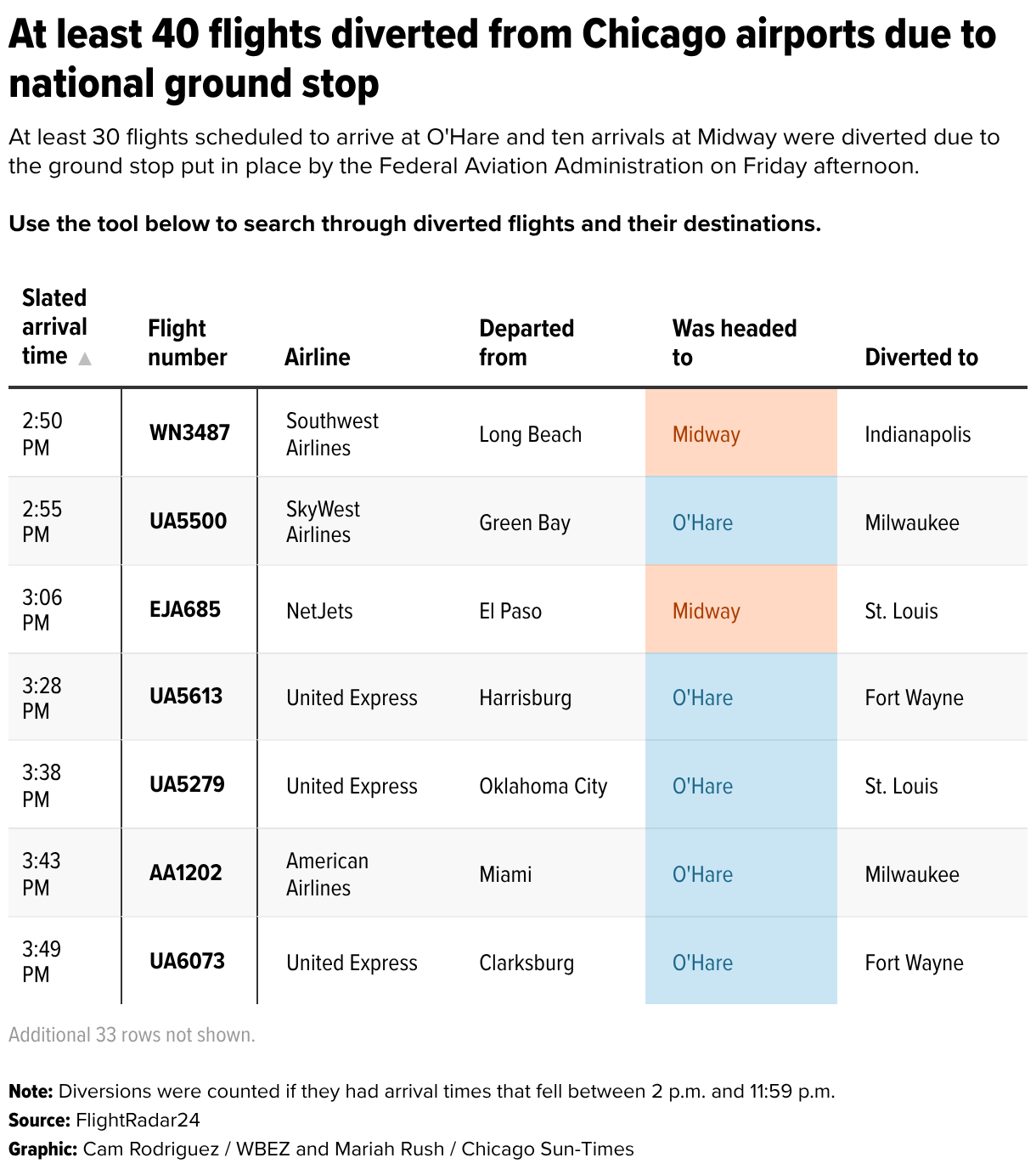
Hours after the Federal Aviation Administration halted all flights across the country Friday, causing widespread delays and cancellations at O'Hare and Midway airports, the agency said departures could resume.
Officials blamed “an incredibly old air traffic control system" for instability in air traffic control communications during a White House briefing Friday evening.
Inside O’Hare International Airport — the busiest airport in the U.S. — confused passengers wandered around as luggage piled up on baggage carousels. Long lines of travelers rummaged through hundreds of bags from flights that never took off because of the delay.
The FAA had grounded all flights nationwide at around 2:36 p.m., and an FAA alert said the stoppage was "due to extraordinary circumstances and for reasons of safety."
At the time, 3,500 airplanes were in the air, U.S. Transportation Secretary Sean Duffy said.
The order was lifted at 7:15 p.m., though it was unclear when flights actually would resume.
A sudden silence fell over O'Hare as travelers were notified that the ground stop had been lifted. But a video board displaying flight information still showed delays or cancellations even though many passengers attempted to buy tickets at nearby airline kiosks.
"For an 18-hour trip back and forth, it doesn't make sense for us and try to go," said Angelica Colmenares, who was en route to Paris for a 48-hour trip with a friend. Luckily, we were flying standby so we didn't fly, but now we're going to have our own party in Chicago."
An hour after the ground stoppage was lifted, American Airlines said it was "prioritizing flights to non-hub cities, as well as international flying, to position aircraft and crew where they are needed to help restore our operation."
"We expect residual delays and cancellations tonight and into tomorrow following the FAA’s nationwide ground stop," the statement said.
Travelers flying to, through, or from select airports on Friday and Saturday — including O'Hare— are eligible for a waived change fee, but changes must be booked by Saturday, according to American Airlines.
United Airlines and Southwest Airlines also offered refunds or changes to flights for free. Chicago-based United noted the reschedule deadline for travel on Friday and Saturday would be Nov. 20.
Southwest offered customers that were traveling on Friday through Monday, Nov. 16 the option to either keep the reservation, rebook within five days of the original travel date or to request a refund. Refunds are eligible for passengers whose flights were canceled or "significantly delayed."
Southwest also noted that while flights had resumed, "customers may continue to experience delays and cancellations."
But most of the flights scheduled through Friday night — all through Southwest — were canceled at Midway.
"We've opened up the airspace," Duffy said. "Now does that mean every flight is going to fly right now? It's going to be slow, right? So if you're watching, and you're at an airport, check with your airline. It depends on do we have crews available, do we have pilots and flight attendants available to fly your flight?"
At O'Hare, many were also canceled, but more were still estimated to depart after long delays.
Some airlines, including JetBlue and Air Canada, had already said they were canceling the rest of their Friday night flights.
U.S. Secretary of Homeland Security Markwayne Mullin said the public was "never in danger" and the flights were grounded due to an "abundance of caution."
By 5:30 p.m., O'Hare had reported 328 flight cancellations and 847 delays. Midway saw 30 canceled flights and 186 delays, according to the Chicago Department of Aviation. At 6:15 p.m., 30 flights scheduled to arrive at O'Hare since 2:55 p.m. had been diverted. Ten arrivals scheduled at Midway were also diverted.
By 10 p.m., O'Hare's number of cancellations had reached 889, and delays hit 990. Midway had 61 canceled and195 delayed.
Duffy said an overload in the FAA's analog telecommunications led to instability that affected all of the nation's 22 air traffic control centers that route planes between airports.
During the evening briefing, Duffy shifted focus to a political fight, saying the Trump administration had been “asking Congress to fully fund a full build of a brand new air traffic control system.”
"[The aircrafts flying] landed... But you will have more of these. You will have more of them unless the American people and Congress tell us to build," he said.
Mullin said there was no sign that "this was a nefarious attack against us. It's just a telecommunications outage."
Although the order was lifted, Duffy said he expected it to take a bit to catch up on flight schedules. “Hopefully (Saturday), we are going to start to see far better movement,” he said.
Earlier at O'Hare, video boards displaying flight information were checkered with red and yellow, signifying the delays and cancellations that forced many travelers to book hotel rooms for the night or rent a car to arrive at their destinations.
Prospect Heights residents Matt and Patricia Kowalski arrived at O’Hare two hours early for their annual holiday trip to visit family in Poland, prepared to board a flight to Germany.
Matt Kowalski learned through the radio on their ride to the airport that a ground stop had occurred, so they decided to wait it out.
By 5 p.m., they had already missed their connecting flight and were debating waiting for the technical issues to pass in the hopes they could keep the trip going.
"It's wild, it's unexpected," Kowalski said.
Mullin said investigators will look at whether there is any link to the FAA's nationwide rollout of a new artificial intelligence system to help identify problems and reroute planes. But that system operates out of one location near Washington, D.C., and just sends recommendations to the air traffic control centers.
The FAA, in a separate statement, said the ground stop was issued "out of an abundance of caution. "Every flight has been accounted for and international flights will be handled on a case-by-case basis," the FAA said.
Nashville resident Paul Lindsay, who was at O'Hare, was on his way to Mason City, Iowa, with friends.
"This is nuts," he said. "It's good to know this is not our problem."
The Chicago Department of Aviation said in a statement that none of its infrastructure was part of the impacted communications system. The department directed questions to the FAA.
U.S. Rep. Jesús “Chuy” García, D-Ill., a member of the House Transportation and Infrastructure Committee, called for more congressional oversight of the FAA and air traffic control in a statement Friday evening.
“My team and I are monitoring the nationwide ground stop that the FAA has ordered, which is causing major travel disruptions and affecting millions nationwide," the statement said. "... I will demand answers from the FAA; Congress must be briefed, and there must be a thorough investigation into the cause of this massive disruption to our aviation system.”
Friday marked the first nationwide ground stop since January 2023, when a key FAA computer system malfunctioned. Before that, the last time had been after the Sept. 11, 2001, terrorist attacks.
The government has been working to overhaul the outdated technology that air traffic controllers rely on since Congress approved $12.5 billion for the project last year. Miles of old copper wires have been replaced with fiber optic lines and old radio systems are gradually being replaced at airports across the country.
But much work remains. Duffy has said that another $30 billion will be needed to complete the work, and the White House has begun lobbying Congress to approve it.
The FAA recently expanded its use of an AI tool that reroutes flights at O'Hare, though there is no indication that the system is related to the ground stop. The system, called Strategic Management of Airspace Routing Trajectories, or SMART, has been used in Washington, D.C., since September.
The FAA this week said it is now being used at O'Hare to reduce delays. The system has been used to reroute 180 flights across the country, the FAA said. Duffy has said the AI tool would offer recommendations to human air traffic controllers, who would remain in control of rerouting flights.
Contributing: Associated Press