
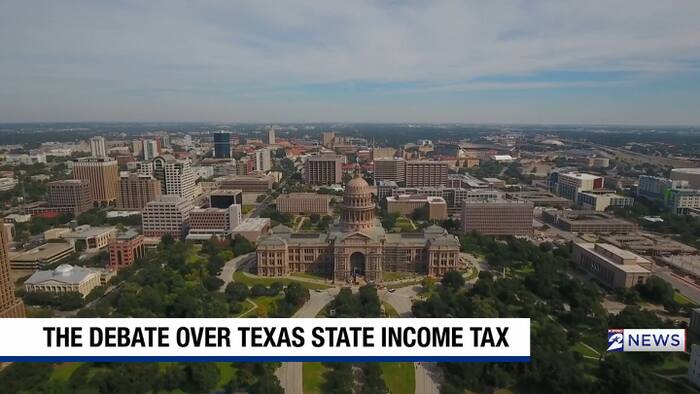
With a new Democratic governor preparing to take office in Texas, some residents are wondering whether the state could eventually impose an individual income tax.
The question comes after KPRC 2 reported on Governor-elect Gina Hinojosa’s proposal to send $1,500 checks to Texas households using money from the state’s Rainy Day Fund.
Some viewers responding to that story raised concerns about whether a change in political leadership could also mean changes to the state’s tax policies.
But imposing an individual state income tax in Texas would require more than the support of a governor. It would mean overcoming several significant constitutional and legislative hurdles.
Texas is one of nine states without a broad-based individual income tax, a distinction that has long been part of the state’s appeal to people relocating from other parts of the country.
For Rebecca Trahan, who spent 21 years living in California before returning to Texas in 2019, taxes and affordability played a major role in her decision.
“It became very unaffordable,” Trahan said of living in California.
Trahan, who works in finance and has a background in Republican politics, said she noticed a difference after moving back to Texas.
“People were living better out here. You could buy more with your money out here,” she said.
But following Democrats’ victories in major statewide races, Trahan worries Texas could eventually adopt policies that increase the cost of living.
“Because I saw it happen this way gradually in California,” Trahan said.
In 2019, Texas voters approved Proposition 4, a constitutional amendment prohibiting the state from imposing an individual income tax.
That means lawmakers cannot simply pass a bill establishing an individual income tax under the current Texas Constitution.
Instead, several steps would be required.
Step 1: Two-thirds approval in the Texas Legislature
Lawmakers would first need to propose a constitutional amendment removing or changing the existing prohibition.
That proposal would require approval from at least two-thirds of both the Texas House of Representatives and the Texas Senate.
With all seats filled, that means at least 100 of the 150 House members and 21 of the 31 senators would need to support the amendment.
Step 2: Approval from Texas voters
Even if the proposed amendment cleared both chambers, it would still need to go before Texas voters.
A majority of voters participating in the constitutional amendment election would have to approve the change.
Step 3: Passage of a separate law creating the tax
Removing the constitutional prohibition would not automatically establish a state income tax.
Lawmakers would still need to pass separate legislation creating the tax, including provisions governing how it would be collected and administered.
Despite concerns raised by some Texans, Hinojosa has publicly stated that she opposes a state income tax.
In one of her campaign advertisements, Hinojosa said:
“Texans work harder than anyone and that’s why our constitution bans a state income tax and that’s why I oppose one.”
For Trahan, the possibility of higher taxes remains a concern as Texas prepares for a change in leadership.
She said some of her friends who relocated from other states have expressed similar worries.
“We moved here for the no state income tax and for things to be more affordable. We fled California because it was all blue. What did we come to?” Trahan said.
Trahan said she is willing to give the incoming administration a chance but has not ruled out leaving Texas if she becomes unhappy with the state’s political direction.


